Calculating Bubbles
BubbleGun is a tool that identifies topological structures in a graph (GFA file). These topological structures can be nested within each other, forming a hierarchical chain of superstructures.
Note
BubbleGun is bundled with PangyPlot (vendored under BubbleGun/ at the repo root) and is invoked automatically during pangyplot add. You do not need to install it separately. This section is for informational purposes.
Structure Definitions
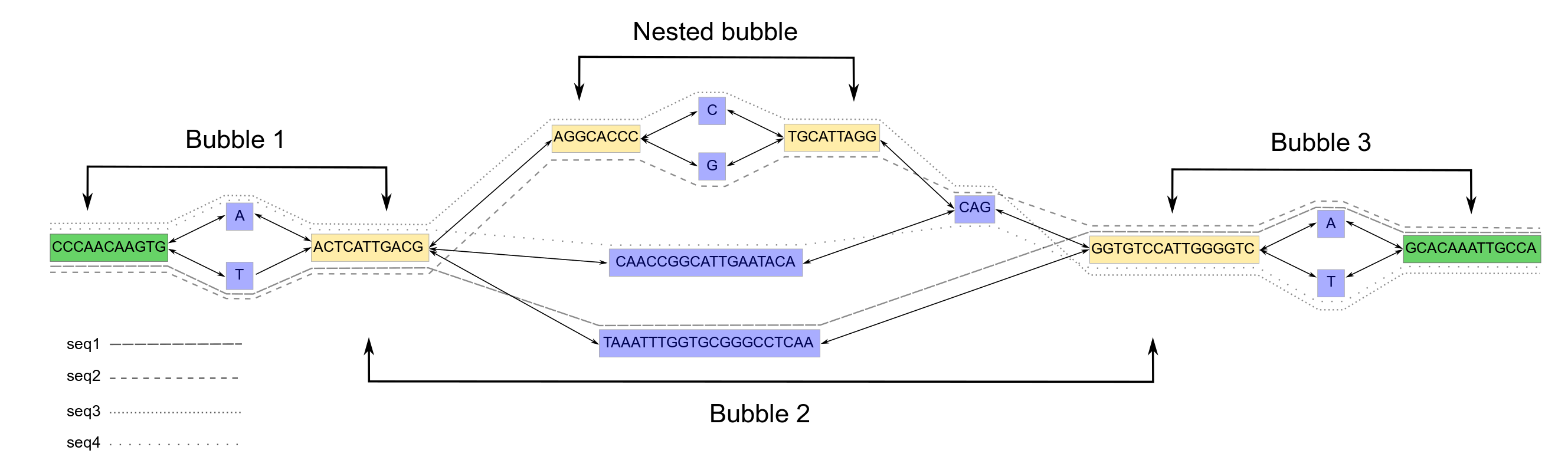
From the BubbleGun publication.
Compacting the Graph
Compacting the graph before bubble detection removes long stretches of trivial, non-branching nodes. Without compaction, these nodes artificially break up bubblechains, making bubbles look smaller or fragmented. By merging them, bubble sources and sinks become clear, bubble boundaries are preserved, and bubblechains reflect the true size of the underlying variation. This also reduces graph noise and improves performance.
PangyPlot will attempt to compact the graph during bubble detection so that bubble chains aren’t disrupted. The data is still stored uncompacted, which means that bubble sources and sinks may contain multiple uncompacted segments.